

The three-day conference, ‘Rethinking Weimar Cinema’, was held on 17th-19th June 2026 at Worcester College, Oxford. Organised by Lawrence Alexander (Ruskin School of Art) and Molly Harrabin (University of St. Andrews/University of Warwick), this event aimed to expand conversations and critical perspectives on film production of the period beyond familiar canons to encompass more recent archival retrievals and restorations, overlooked practitioners, and marginalized identities. The event brought together scholars, archivists, curators, and film restoration specialists from across Europe, North America, and South Asia with a programme that reflected the richness and diversity of responses to the Call for Papers. We were also fortunate to include three generative keynote talks from researchers who serve as touchstones for the conversations we hoped to facilitate during the conference. Dr Sara F. Hall (University of Illinois Chicago) presented an in-depth account of police films during the period; Dr Paul Dobryden’s (University of Virginia) keynote considered questions of selection and disposability across casting and production practices; and Dr Qinna Shen’s (Bryn Mawr College) presentation offered a survey of films constituting Fritz Lang’s ‘Asian obsession’. The sense of momentum that has emerged from this conference is clear and the organisers anticipate that plans for publication projects will begin in earnest in the Autumn of this year.
As a complement to the conference programme, two public-facing screenings at Oxford’s Ultimate Picture Palace brought together conference delegates and members of the local community. These included a screening of Dr Arnold Fanck’s Der heilige Berg (The Holy Mountain, 1926) introduced by Dr Ian Roberts as part of the Weimar 100 project and a new restoration of Richard Eichberg’s Song (1928) introduced by the man who restored it: Andreas Thein, Head of Collections and Restorations at the Filmmuseum Düsseldorf.
The conference was generously supported by the DAAD ‘Promoting German Studies’ grant, the Association of German Studies (AGS), the British Association of Film, Television, and Screen Studies (BAFTSS), the Leverhulme Trust, and the Institute of Advanced Study (University of Warwick). The conference organizers wish to thank all those who provided financial, logistical, and moral support to the organization of this event.

Rethinking Weimar Cinema conference delegates 
Sara F. Hall (University of Illinois Chicago) delivers her keynote lecture 
Ian Roberts (University of Warwick) at the Weimar 100 screening of Der heilige Berg at the Ultimate Picture Palace 
Paul Dobryden (University of Virginia) delivers his keynote lecture 
Andreas Thein (Filmmuseum Düsseldorf) at the screening of Song. Die Liebe eines armen Menschenkindes at The Ultimate Picture Palace 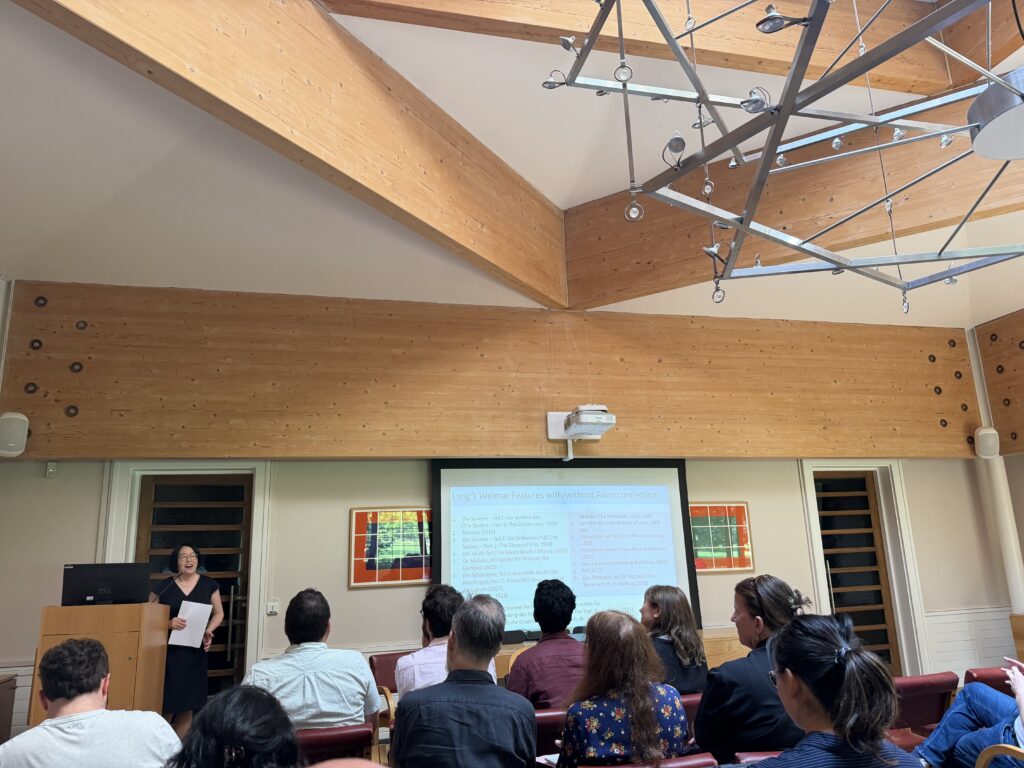
Qinna Shen (Bryn Mawr College) delivers her keynote lecture 
Rethinking Weimar Cinema conference delegates outside The Ultimate Picture Palace